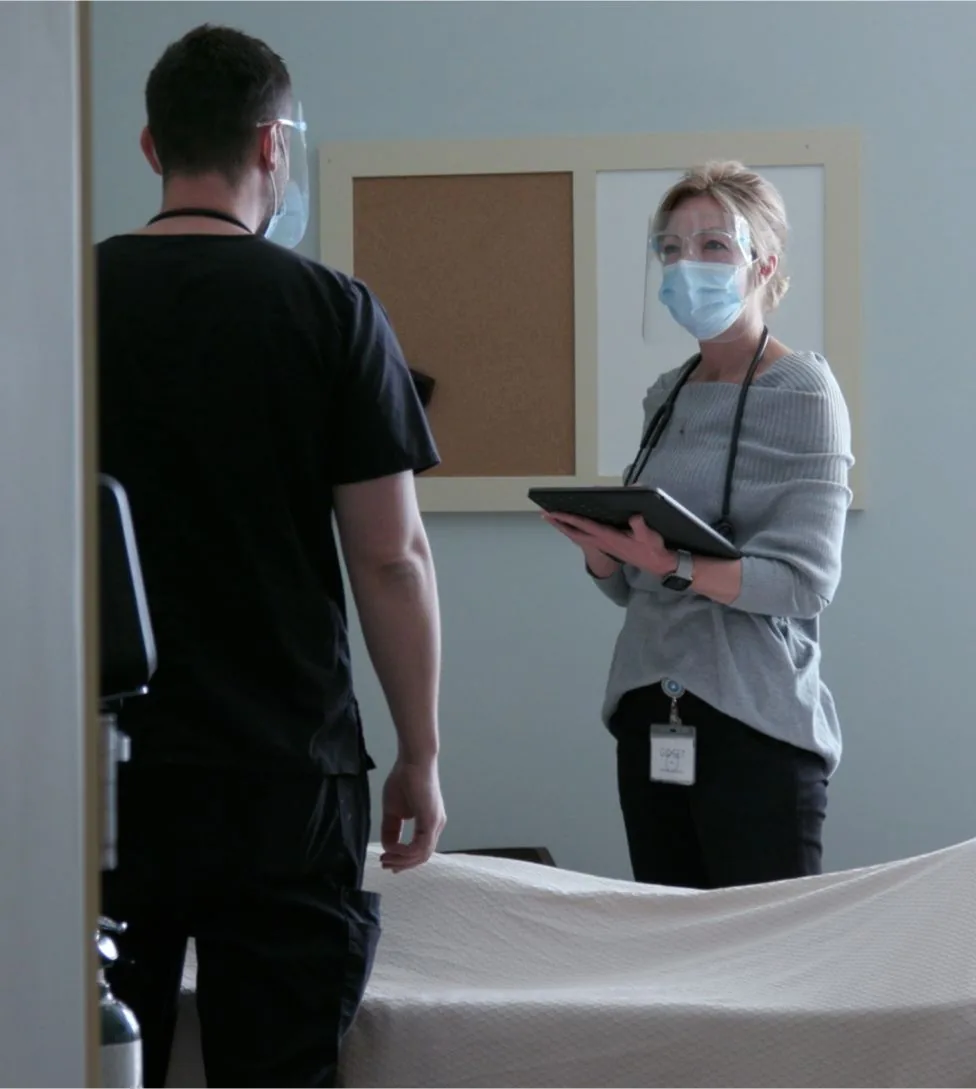
A chronic respiratory case study demonstrating how a motivated patient, a clear goal, and a highly skilled multidisciplinary clinical team can successfully reverse long-term ventilator dependency.
Case Summary & Outcomes
For patients with long-term ventilator dependence, the post-acute care setting is often viewed as a permanent residential destination rather than a transitional stepping stone. This was the reality facing a 73-year-old military veteran who had been ventilator-dependent for three consecutive years following a severe bout of pneumonia that led to acute-on-chronic respiratory failure. He had been intubated, proved impossible to wean, and ultimately received a tracheostomy. Following the closure of the post-acute ventilator unit where he resided, he was transferred to Ohman Family Living at Briar — a VA-accredited provider.
Prior to his admission, the patient had not stood or walked in three years, relying entirely on full caregiver support and a mechanical lift for basic transfers. Upon developing his baseline care plan, the patient shared a single, clear goal: "I want a chance to wean from the ventilator and return home."
Ohman Family Living at Briar set out to deliver that chance.
The Multidisciplinary Care Pathway
Reversing three years of ventilator dependence and muscle atrophy requires a coordinated, multidisciplinary effort. Under physician leadership, a team comprising physical therapy, occupational therapy, respiratory therapy, speech-language pathology, and advanced nursing aligned around a single rehabilitation pathway.
The lead care team included:
- Dennis Lagman, M.D. — Attending Physician
- Alex Mostoller, RT — Respiratory Therapy Lead
- Gidget Petronelli, RN — Nursing Lead
- Anthony Livingston, PTA / Keeley Chaffee, PT — Physical Therapy
- Jen Cencula, SLP — Speech-Language Pathology
- Alison Hoskin, OTR/L — Occupational Therapy
Respiratory Weaning & Decannulation
The weaning protocol commenced with progressive daytime tolerance tests. First, the patient began tolerating a capped tracheostomy tube with the balloon deflated. The respiratory therapy team tracked arterial blood gases (ABGs) and monitored blood oxygenation continuously using **Masimo remote monitoring telemetry** during each adjustment.
Once daytime tolerance was established, the mechanical ventilator was successfully replaced with bedroom BiPAP support. Over several weeks of progressive titration, the respiratory lead protocols helped the patient achieve full breathing independence, culminating in the bedside removal (decannulation) of his tracheostomy tube by the lead respiratory therapist — completed without clinical complication.
Rebuilding Physical Independence
Parallel to his respiratory weaning, the physical and occupational therapy teams focused on reversing three years of profound muscle deconditioning. The rehab plan utilized progressive standing balance and leg-strengthening exercises to rebuild the endurance required for transfers.
To prepare for a successful discharge home, the occupational therapy team trained the patient's family on safe mechanical lift use, wheelchair propulsion, and daily home-management protocols, ensuring a sustainable caregiver framework.
Discharged Home with Zero Vent Dependency
Ninety days after entering Ohman Family Living at Briar, the patient successfully discharged home to West Virginia. He returned home breathing entirely on his own — with his tracheostomy tube completely removed, his respiratory failure resolved, and his physical function restored to allow for active home-level mobility.
Conclusion
This case study proves that long-term ventilator dependency is not a permanent sentence — even after 36 consecutive months of mechanical support. By pairing a motivated patient with highly skilled clinical specialists, advanced diagnostic technology, and a structured multidisciplinary rehabilitation pathway, Briar demonstrated that full weaning and decannulation can be achieved, helping a military veteran return home in 90 days.